
Approved motorcycle trousers: classes A, AA, AAA and knees
 Written by the MotoComparo team, independent comparison site · prices checked every day
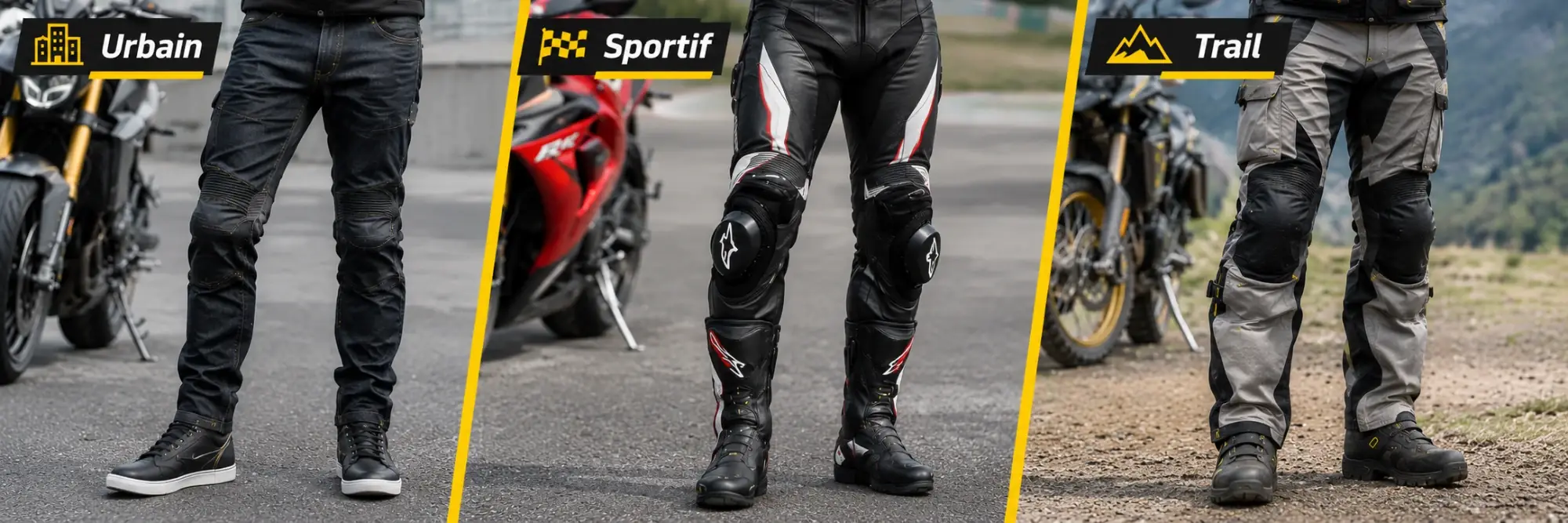
Key points
- Trousers are not a legal requirement in France, unlike gloves; “approved” here means that the garment has been put through the tests of EN 17092, which places it in a class.
- The classes read from the most protective to the lightest: AAA, AA, A. Classes B and C do not cover a complete pair of trousers: B has no impact protectors, C only serves to hold protectors in place.
- Knee armour comes under another standard, EN 1621-1, which has two levels: 1 and 2. The class of the trousers does not tell you the level of the armour.
- A listing that says nothing about the class or the armour proves nothing: the label sewn into the trousers and the manufacturer's instructions are what count.
This article is for anyone buying motorcycle trousers or jeans and running into similar-sounding words on listings: “approved”, “CE”, “with protectors”, “class AA”. It explains what the law says, what EN 17092 classifies, what the armour standard measures, then what the catalogue listings declare. The tables come from MotoComparo and are recalculated when the page is opened; the technical and legal facts refer to the sources listed at the end of the article. The site has no test bench: no trousers have been tried on.
What the law requires
The French Highway Code requires gloves: on the road, every rider or passenger of a motorcycle must wear gloves that comply with the regulations on personal protective equipment (PPE), on pain of the fine for third-class offences and the loss of one licence point (article R431-1-2, Légifrance, in force since 20 November 2016).
The Service-Public page on compulsory equipment for riding a motorcycle (checked on 16 June 2026) lists the helmet, gloves and high-visibility vest, then the lighting, number plate, steering lock, horn and exhaust. It mentions neither trousers, nor a jacket, nor boots. Trousers are therefore not required by these texts. That does not make them optional as far as protection goes: the road safety authority (Sécurité routière) presents trousers as personal protective equipment certified as such, with a “CE” label, and recommends protectors for the hips and knees (“Trousers” page).
EN 17092: five classes
EN 17092 covers motorcycle clothing for road use. It has six parts: the first describes the test methods, the next five set the requirements of each class (Eurofins). The label of a pair of trousers shows one of these classes.
- Class AAA (part 2): the highest level of protection. The SATRA laboratory cites one- or two-piece suits as examples, which may come with weight and heat constraints (SATRA).
- Class AA (part 3): a medium level of protection (Eurofins). The BSI catalogue Describes it as limited protection against abrasion and impact for road use, published on 31 March 2020.
- Class A (part 4): light protection, the minimum necessary (Eurofins).
- Class B (part 5): the abrasion resistance of class A, without impact protectors.
- Class C (part 6): a garment designed only to hold one or more impact protectors in place, with no minimum abrasion requirement (SATRA, EN 17092).
What the standard measures
According to SATRA (EN 17092), the fabric undergoes an impact abrasion test, on the machine known as the Darmstadt, which simulates a slide until it comes to a stop; the test is passed when the layer closest to the body shows no hole of 5 mm or more. Seams, zips and protector pockets are assessed for their strength, and the fabric for its tear resistance. The areas of the garment are not all treated in the same way: the standard distinguishes zones at high, medium or low risk of damage (SATRA, article on the draft version).
These sources describe abrasion, tearing, seams and impacts. Waterproofing does not appear in them: class AA trousers are not waterproof because they are class AA. For rain, see motorcycle equipment for the rain.
Protectors: what the class requires, and what it does not say
The class determines whether impact protectors must be present. According to SATRA, elbow, shoulder, knee and hip protectors are mandatory in class AAA and AA garments; in class A, only hip protectors are optional (SATRA, EN 17092). Eurofins sums up the rule thus: from class A upwards, impact protectors must be built into the garment. For trousers, the areas concerned are the knees and hips. A listing for class A trousers may therefore legitimately have knee armour only.
The armour itself comes under another standard, EN 1621-1, devoted to limb joint protectors. It sets two performance levels, 1 and 2, and the testing body SATRA states that the lower the force transmitted by a protector, the more protective it is judged to be (SATRA, EN 1621). Level 2 is therefore the more demanding of the two. The standard's numerical thresholds are not public: check the level on the label of the armour or in the manufacturer's instructions.
Two things are therefore distinct on a listing: the class of the trousers (AAA, AA or A, EN 17092) and the level of the armour (1 or 2, EN 1621-1). The catalogue records them separately, and also distinguishes armour supplied from a pocket merely prepared: trousers whose listing says “prepared for hip protectors” do not come with any.
What the listings in our catalogue declare
The following three tables count the comparable trousers in the catalogue (sold by at least two merchants, with a known price) according to what their merchant listing states. They count what merchants declare: a listing that says nothing does not mean the trousers lack the feature.
Declared EN 17092 class
| EN 17092 class | Fiches | Median price | Lowest price |
|---|---|---|---|
| AA | 723 | 170,07 € | 13,99 € |
| A | 554 | 134,93 € | 55,00 € |
| AAA | 204 | 195,07 € | 79,99 € |
| B | 1 | 99,00 € | 99,00 € |
Of 2 988 comparable listings in the category, 1 482 state this feature on their merchant page (50%). The others simply do not mention it — it is not a confirmed absence.
Among the listings that specify it, the most frequently declared class is “AA”.
The median price of listings declared class AA is 170,07 €, against 134,93 € for class A. These two groups mix different brands, materials and uses: the gap between medians does not measure what the class adds to the price of the same trousers.
Declared knee armour level
| EN 1621-1 knee level | Fiches | Median price | Lowest price |
|---|---|---|---|
| 1 | 496 | 144,00 € | 23,95 € |
| 2 | 396 | 199,96 € | 7,96 € |
Of 2 988 comparable listings in the category, 892 state this feature on their merchant page (30%). The others simply do not mention it — it is not a confirmed absence.
Among the listings that specify it, the most frequently declared level for the knees is “1”.
Knee armour: supplied or prepared
| Knee armour | Fiches | Median price | Lowest price |
|---|---|---|---|
| Supplied | 1 927 | 149,95 € | 7,96 € |
| Prepared | 82 | 141,75 € | 65,99 € |
Of 2 988 comparable listings in the category, 2 009 state this feature on their merchant page (67%). The others simply do not mention it — it is not a confirmed absence.
Jeans, textile or leather: the material does not make the class
The EN 17092 class cannot be deduced from the material or from the model name. A garment comes under a class only if it has been put through the tests of a third-party body under the standard (Eurofins). A “motorcycle” jean with no class on its listing or its label is therefore not, as it stands, a classified jean; a jean advertised as class A or AA must be able to prove it with the EN 17092 mention and the corresponding letter.
The catalogue lets you cross the two criteria. You can display jeans and denim trousers, Textile trousers gold leather trousers, then narrow down to one class with the approval filter. The material remains the one the merchant declares: checking always comes down to the label.
How to choose
The following order applies to all listings: the class first, then the protectors, then everyday use.
- The EN 17092 class. Class AAA describes the highest protection, class AA a medium level of protection, class A light protection. The criterion rests on use: road and touring, urban commuting, track.
- Knee armour. Check that it is supplied and not merely prepared, then read its level (EN 1621-1, level 1 or 2).
- The hips. Mandatory in class AA and AAA, optional in class A (SATRA): the listing must say whether they are supplied, optional or absent.
- Visibility. The road safety authority (Sécurité routière) recommends fluorescent and retroreflective inserts on the trousers.
- Everyday use. So that you do not keep motorcycle trousers on all day, the road safety authority (Sécurité routière) points to trousers with removable protectors, sold by specialist shops.
Listing pitfalls
- “CE” alone. The CE marking indicates personal protective equipment covered by European regulation 2016/425; it does not give the class, which is read with the EN 17092 reference.
- “With protectors”. The wording does not say which ones (knees, hips), nor their level, nor whether they are supplied.
- The vintage. A listing that cites EN 13595 refers to a withdrawn standard (SIS); ask for the EN 17092 reference.
To compare today's prices
- Class AA trousers, class A trousers and class AAA trousers under EN 17092.
- Winter trousers compared.
- All trousers, with the material, approval and season filters.
- The winter jacket follows the same standard; gloves, the only equipment required by law, have their own.
- Standards for clothing and protectors (EN 17092, EN 1621, EN 13594).
- Comparing two prices without being misled, and the current deals to spot the price drops recorded in the catalogue.
Frequently asked questions
Are motorcycle trousers compulsory?
No. The texts consulted require the helmet, gloves and high-visibility vest without citing trousers. Only gloves are covered by an article of the French Highway Code, R431-1-2, with a fine and the loss of one point.
What does class AA motorcycle trousers mean?
The trousers come under part 3 of EN 17092, which describes a medium level of protection against abrasion and impact (Eurofins, BSI). Knee and hip protectors are mandatory in it (SATRA).
What is the difference between class A, AA and AAA?
Class AAA is the most protective, class AA offers medium protection and class A light protection (Eurofins). In class A, hip protectors are optional (SATRA).
Are motorcycle jeans approved?
Only if they carry an EN 17092 class on their label. A garment has a class only if it has been put through the tests of a third-party body (Eurofins); the material, or the word “motorcycle” in the name, is not enough.
Knee armour level 1 or level 2?
EN 1621-1 provides for these two levels and judges a protector the more protective the less force it transmits (SATRA). Level 2 is the more demanding according to Wikipedia, a secondary source. It can be read on the listing and on the armour itself.
Sources
- Article R431-1-2 of the French Highway Code, Légifrance.
- Compulsory equipment for riding a motorcycle, Service-Public (DILA), page checked on 16 June 2026.
- “Équipez-vous” campaign, “Trousers” page, Sécurité routière.
- Regulation (EU) 2016/425 on personal protective equipment, EUR-Lex.
- Safeguarding bikers: navigating EU regulations for motorcyclist protective garments, Eurofins.
- BS EN 17092-3:2020, class AA, BSI.
- EN 17092, protective clothing for motorcycle riders, SATRA.
- Testing motorcyclists' PPE, SATRA (article written on the draft version of the standard).
- EN 1621, motorcyclists' protectors, SATRA.
- SS-EN 13595-1, status withdrawn, SIS (Swedish standards body).
Read also
- Visor fogging: Pinlock supplied, prepared or absent
What the Pinlock insert does against fogging, and the difference between a helmet supplied with the insert or only prepared for it: what the catalogue listings state.
- Winter motorcycle boots: the EN 13634 standard and waterproofing
The four digits of the EN 13634 standard on a motorcycle boot, and why it does not guarantee waterproofing: what the catalogue listings state.
- Heated motorcycle gloves: what to know before buying
Battery or connection to the motorcycle, heat levels, claimed battery life, EN 13594 standard: what manufacturers say and what the listings declare.

