
Heated motorcycle gloves: what to know before buying
 Written by the MotoComparo team, independent comparison site · prices checked every day
Key points
- A heated glove is still a glove: it must comply with the regulations on personal protective equipment, like any pair, and carry the CE marking.
- The first question is the power supply: a battery in the glove, a connection to the motorcycle's battery, or both depending on the model.
- The heat levels and battery life are those the manufacturer claims; they depend on the setting, the cold and the charge, and MotoComparo has not measured any of them.
- Heat levels have nothing to do with levels 1 and 2 of the EN 13594 Standard, which describe protection in a fall.
This article is for anyone who rides in autumn and winter, and wonders whether a heated glove is worth it compared with a good winter glove. It explains how these gloves work, the two power supply modes, what the law and the standard require, and then what the listings in the MotoComparo catalogue declare. The tables are recalculated when the page opens; the technical and legal facts come from the manufacturers and the official texts listed at the end of the article. The site has no test bench: no glove has been worn, no heating time has been measured.
How a heated glove works
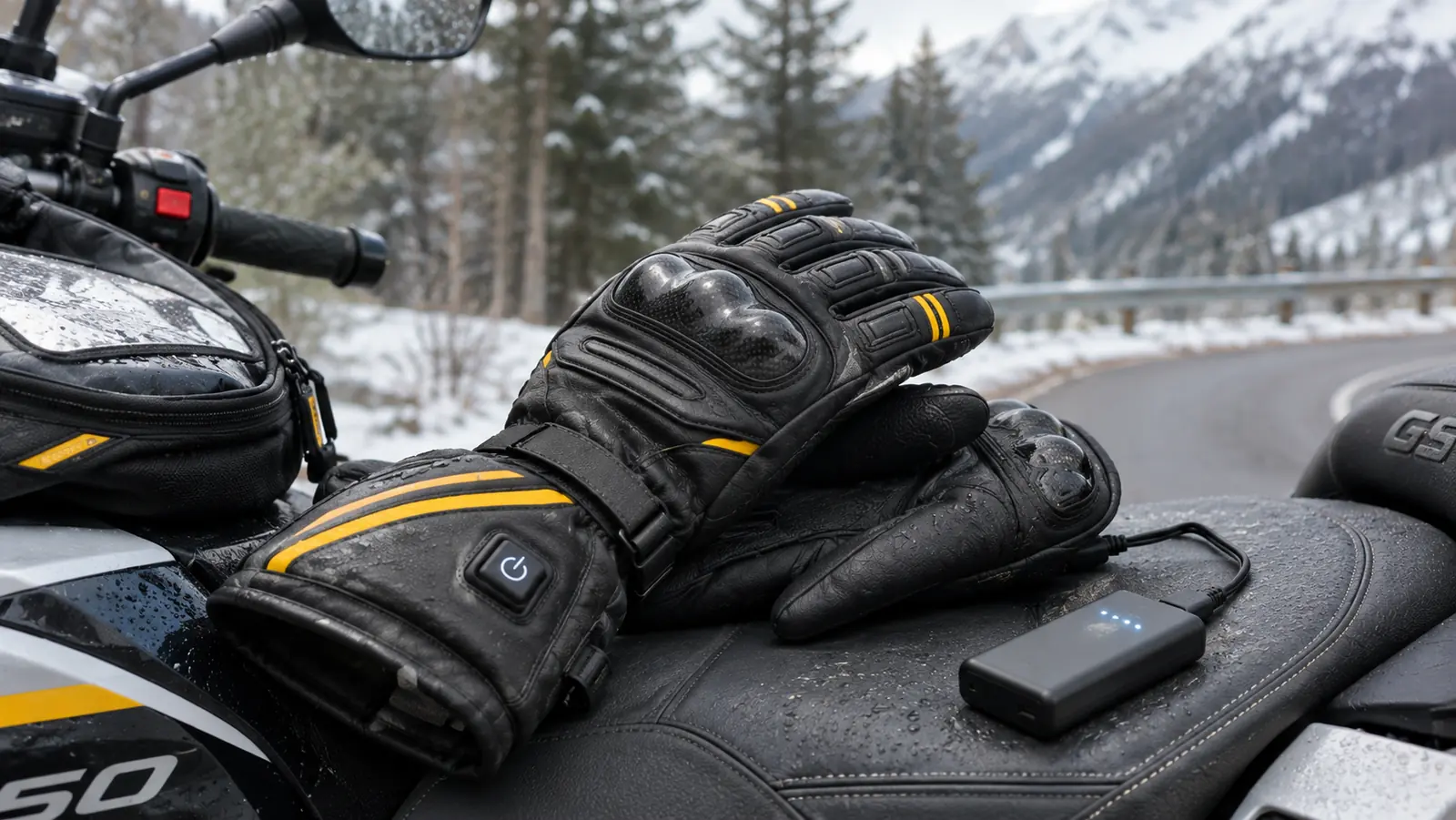
A heated glove is a motorcycle glove to which an electrical circuit that produces heat has been added. Manufacturers describe heating elements built into the glove, a power source, and a way of adjusting the intensity. For winter gloves without heating, see our guide summer, mid-season or winter motorcycle gloves.
The French manufacturer Five explains, for example, that its HG gloves use resistors (conductors that heat up when current passes through them) placed on the back of the hand and on the fingers, as far as the last phalanx. The palm has no resistor: a thin layer of thermal insulation is provided there to preserve grip on the handlebar (“HG heated gloves” page, Five). The same manufacturer states that the heat felt depends on speed, outside temperature, wind, the length of the journey and each person's sensitivity to cold.
Battery in the glove or connection to the motorcycle
Heated gloves fall into three power supply types, which the manufacturers themselves cite.
- The battery in the glove. Five quotes batteries of 7.2 V (volts) and 2.2 Ah (amp-hours, the battery's capacity), which recharge in about four hours with the dual charger supplied and can stay in their glove pocket while charging. For its HT-5 model, Alpinestars describes a 7.4 V lithium battery per glove, recharged by a Y-shaped USB cable that links the two batteries (HT-5 page, Alpinestars).
- The connection to the motorcycle. Gerbing, whose system runs on 12 V DC, powers its gloves from the motorcycle's battery. Each installation requires a battery harness and a temperature controller (12 V FAQ, Gerbing). Five offers a kit that connects its gloves to the cigarette lighter socket or to the motorcycle's battery.
- Both. Macna calls “Dual Power” a system where the choice between 7.4 V and 12 V is not final: the same pair can take a battery or a connection to the motorcycle (Tech Lab, Macna).
According to Macna, a 12 V supply heats faster and reaches higher temperatures than 7.4 V. The manufacturer adds that you should compare equivalent heating outputs rather than level numbers: level 1 at 12 V is close, it says, to level 3 at 7.4 V (“Heated Setup” page, Macna).
Heated zones and heat levels
The gloves offer several intensity levels, set by a button on the glove or by an app. At Five, three levels correspond to 45 °C (Eco), 50 °C (Regular) and 60 °C (Boost), values that the manufacturer says it sends into the circuit. At Macna, four levels range from 40 to 100 % of power, each associated with a colour on the indicator; the Bluetooth app uses the same steps and lets you programme the gloves to switch off automatically. For its HT-5, Alpinestars states three settings and separate regulation for each hand.
These figures describe the glove's circuit, not the temperature of your skin. Manufacturers do not promise the same thing: a set-point temperature from one, a percentage of power from another. Two models therefore cannot be compared level against level.
Battery life as claimed by manufacturers
The battery life of a battery-powered glove is the length of time it heats before the battery is empty. MotoComparo has not measured any; here is only what the manufacturers say.
- Five claims up to six hours in Eco mode and about two hours in Boost mode, the actual duration varying with the charge of the battery, the temperature and the humidity.
- Macna gives, on the page consulted, no duration in hours for its gloves. It states that the higher the battery's amperage, the longer the use between recharges.
- Alpinestars states neither the battery capacity nor the duration, on the page consulted for the HT-5 model.
A claimed duration applies to the conditions described by the manufacturer. Macna states that, to have a 12 V supply with no time limit, you must connect the gloves to the motorcycle by cables.
What the law and the standard require
On the road, the rider and passenger of a motorcycle must wear gloves that comply with the regulations on personal protective equipment. Failing to do so is punished by a third-class fine, with the loss of one licence point (article R431-1-2 of the Highway Code, Légifrance, in force since 20 November 2016). The text says “gloves” without distinguishing heated gloves from others: the rule therefore applies to them like any other pair. The Service-Public page adds that gloves must carry the CE marking (“Mandatory equipment for riding a motorcycle”, page checked on 16 June 2026).
The standard for motorcycle gloves is EN 13594:2015. According to the testing body SATRA, it covers protection of the hands and wrists in an impact or a slide on the road, while retaining enough dexterity to operate the controls. It sets two levels: level 1, for gloves with low restriction, and level 2, for gloves that are more protective, with mandatory knuckle protection (EN 13594:2015, SATRA). SATRA's presentation does not mention heating: the standard describes protection, not the quality of the heating.
A manufacturer can therefore display both. Alpinestars writes that its HT-5 is a CE-certified level 1 KP protective garment (KP stands for tested joint protection), without naming EN 13594 on the page consulted. Conversely, Five's “HG heated gloves” page mentions neither a CE marking nor a standard; that says nothing about the product's compliance, only that this page does not state it. The label sewn into the glove and the manufacturer's instructions remain the documents that count.
What the listings in our catalogue declare
The following tables count the comparable gloves in the catalogue (sold by at least two merchants, with a known price) according to what their merchant listing states. They count what merchants declare: a listing that says nothing does not mean the glove lacks the feature.
Declared heating system
| Heated | Fiches | Median price | Lowest price |
|---|---|---|---|
| Yes | 147 | 149,00 € | 8,96 € |
Of 3 752 comparable listings in the category, 147 state this feature on their merchant page (4%). The others simply do not mention it — it is not a confirmed absence.
Among the comparable gloves in the catalogue, 147 listings declare a heating system, at a median price of 149,00 €. The catalogue holds no feature on voltage (7.4 or 12 V), on the power supply mode or on battery life: this information is read in the description of each listing and in the manufacturer's instructions.
Declared season
| Season | Fiches | Median price | Lowest price |
|---|---|---|---|
| Summer | 1 482 | 47,99 € | 10,99 € |
| Summer | 792 | 43,07 € | 10,99 € |
| Winter | 703 | 59,25 € | 7,90 € |
| Mid-season | 641 | 62,00 € | 13,01 € |
Of 3 752 comparable listings in the category, 3 618 state this feature on their merchant page (96%). The others simply do not mention it — it is not a confirmed absence.
As a benchmark, the median price of gloves declared “winter” is 59,25 €, compared with 149,00 € for gloves declaring a heating system: the heated group is more expensive at the median price. These two groups may overlap, and the price of a heated glove may or may not include the batteries: it is a benchmark, not a verdict.
Declared approval
| Approval | Fiches | Median price | Lowest price |
|---|---|---|---|
| EN 13594 | 1 641 | 53,97 € | 16,77 € |
| CE | 625 | 52,00 € | 11,99 € |
Of 3 752 comparable listings in the category, 2 266 state this feature on their merchant page (60%). The others simply do not mention it — it is not a confirmed absence.
A listing that states only “CE” signals an item of personal protective equipment without citing the standard: it is the merchant who has not copied the reference, not necessarily the glove that lacks it. This table covers all gloves in the category, heated or not: the catalogue does not cross the two features in this article.
How to choose
In order, the questions to ask before looking at prices.
- How is the glove powered? A battery in the glove avoids any cable; a connection to the motorcycle avoids recharging but requires installation (harness, fuse, controller for Gerbing). Dual-power models leave both options open.
- Is the battery supplied? At Macna, it is not always. Check whether the listing sells a kit or the pair alone.
- What settings does the manufacturer describe? Number of levels, button or app, separate regulation for each hand.
- What battery life is claimed, and under what conditions? A duration without the corresponding heat level cannot be compared with anything.
- What does the protection label say? Look for the 13594 reference and the level. Heating does not replace protection.
Connection precautions
Gerbing asks you to connect the battery's positive terminal first, then the negative terminal, and to fit the fuse last. The sum of the values of the connected garments determines the fuse to use, and each rider must have their own harness, their own cord and their own controller. The manufacturer advises against switching the equipment on when the engine is off or running below the stated speed, at the risk of damaging the equipment and the electrical circuit. For any other manufacturer, the instructions take precedence.
Before buying, and to compare prices
- Size. Sizes do not correspond from one brand to another: compare your measurements with the brand's guide, as for an ordinary winter glove.
- Waterproofing. A heating system says nothing about water. The difference between membrane and water-repellent is covered in the feature on rainwear.
- The rest of the body. The hands are only one part of winter kit; see the winter jacket guide.
- Care. Follow the manufacturer's instructions, which take precedence over the general advice in an article.
To compare today's prices:
- Heated gloves in the category, by searching for the word “chauffants” (a word search, not a feature filter: it may bring up accessories).
- Winter gloves compared, to place a heated glove against an ordinary winter glove.
- Gloves that cite the 13594 standard, including level 1 and level 2.
- All gloves, with filters for season, approval, material and brand.
- The electronics category, for the electronic equipment in the catalogue.
- Standards for clothing and protectors (EN 17092, EN 1621, EN 13594) and comparing two prices without being misled.
- The current deals, to spot the price drops recorded in the catalogue.
Frequently asked questions
Does a heated glove have to be approved like any other glove?
Yes. Article R431-1-2 of the Highway Code requires gloves that comply with the regulations on personal protective equipment, without distinguishing heated gloves, and Service-Public states that gloves must carry the CE marking. The reference standard for protection is EN 13594 (SATRA).
Is a battery in the glove or a connection to the motorcycle better?
Manufacturers describe three cases: battery in the glove (Five, Alpinestars), connection to the motorcycle at 12 V (Gerbing), or both (Macna). Macna states that 12 V heats faster and reaches higher temperatures than 7.4 V. The choice depends on the length of your journeys and your tolerance for an installation on the motorcycle.
What is the battery life of a heated glove?
It depends on the model, the setting and the conditions. The manufacturer Five claims up to six hours in Eco mode and about two hours in Boost mode, depending on charge, temperature and humidity. MotoComparo has not measured any duration: refer to the model's listing and instructions.
Do heat levels correspond to levels 1 and 2 of EN 13594?
No. Heat levels set the intensity of the heating (four levels at Macna, three at Five). Levels 1 and 2 of EN 13594 describe protection in a fall and the glove's ergonomic restriction (SATRA).
Can you filter heated gloves on MotoComparo?
Not with a dedicated filter in the gloves category. The catalogue reads a “heated” feature on the listings that declare it and counts it in this article, but holds no voltage, power supply mode or battery life. A word search in the category lets you find heated gloves.
Sources
- Article R431-1-2 of the Highway Code, Légifrance.
- Mandatory equipment for riding a motorcycle, Service-Public (DILA), page checked on 16 June 2026.
- EN 13594:2015, protective gloves for motorcycle riders, SATRA.
- HG heated gloves, Five.
- Heated Setup, Macna.
- Tech Lab, Dual Power Technology, Macna.
- 12V Frequently Asked Questions, Gerbing.
- HT-5 Heat Tech Drystar gloves, Alpinestars.
Read also
- Summer, mid-season or winter motorcycle gloves: how to choose
EN 13594, level 1 or 2, membrane or water-repellent: what sets a summer motorcycle glove apart from a winter one, backed by catalogue figures.
- Visor fogging: Pinlock supplied, prepared or absent
What the Pinlock insert does against fogging, and the difference between a helmet supplied with the insert or only prepared for it: what the catalogue listings state.
- Winter motorcycle boots: the EN 13634 standard and waterproofing
The four digits of the EN 13634 standard on a motorcycle boot, and why it does not guarantee waterproofing: what the catalogue listings state.

