
Winter motorcycle boots: the EN 13634 standard and waterproofing
 Written by the MotoComparo team, independent comparison site · prices checked every day
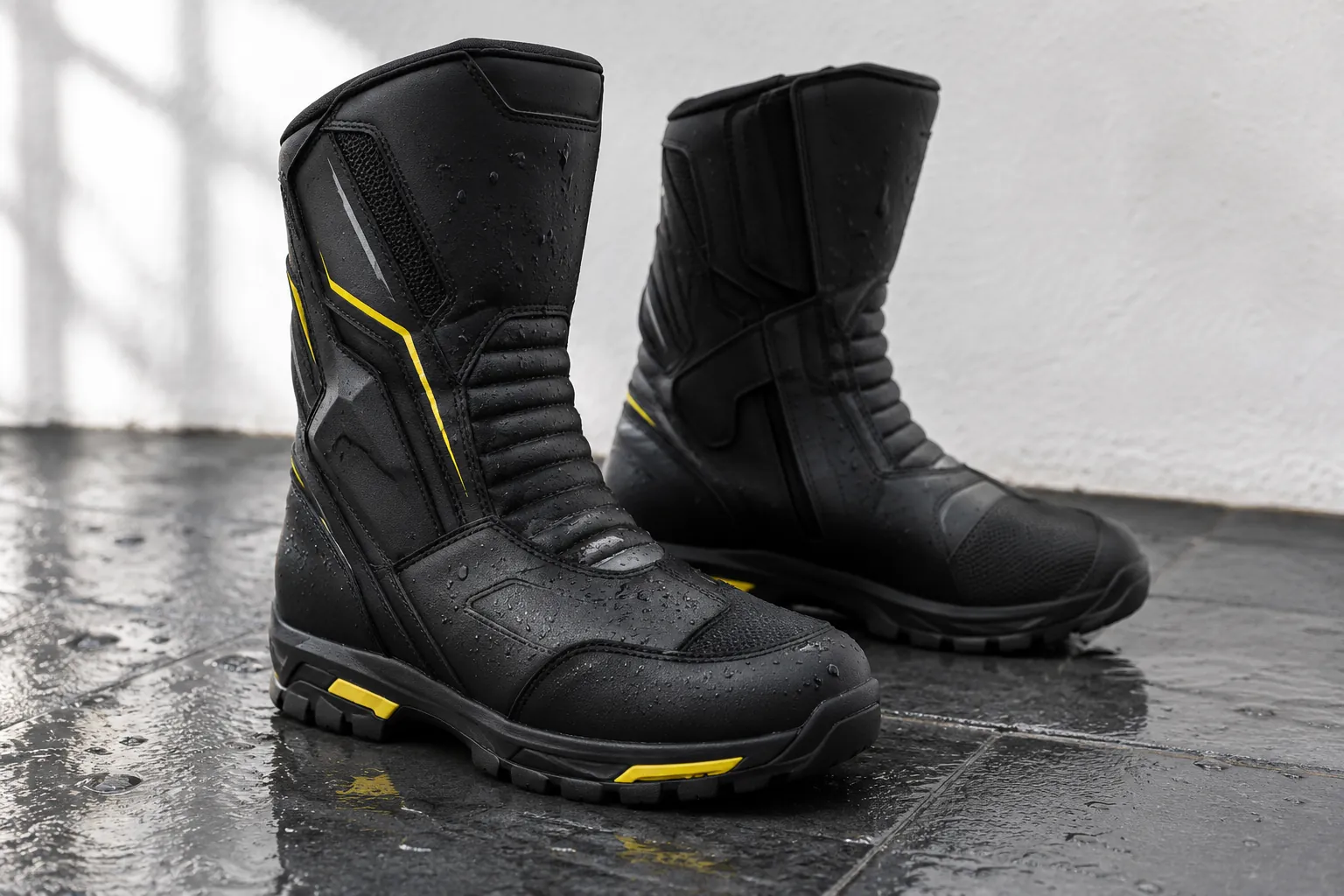
Key points
- The EN 13634 Standard is the standard for motorcycle boots. Its marking carries four digits, in this order: shaft height, abrasion, cut and transverse rigidity.
- The standard does not require waterproofing: resistance to water penetration is an optional test, which the manufacturer chooses whether or not to carry out. An “EN 13634” boot is therefore not necessarily waterproof.
- For winter, read the listing in this order: the standard and its digits, then the waterproofing or membrane mention, then the material.
- A listing that says nothing proves nothing: the label sewn into the boot and the manufacturer's instructions are what count.
This article is for anyone buying motorcycle boots to ride in winter who is struggling with the words on the listings: “CE-approved”, “CE”, “EN 13634”, “waterproof”. It explains what the standard examines, how to read its marking, and then what the listings in the catalogue declare. The tables come from MotoComparo and are recalculated when the page opens; the technical and legal facts refer to the sources listed at the end of the article. The site has no test bench: no boot has been tested.
What the law requires
The Highway Code requires gloves (article R431-1-2, Légifrance). The Service-Public page on mandatory equipment for riding a motorcycle (checked on 16 June 2026) lists the helmet, gloves and a high-visibility vest. It does not mention boots: they are not required by these texts. That does not make them optional when it comes to protection, and it is the EN 13634 standard that makes it possible to compare one boot with another.
What the 13634 standard examines
The EN 13634 Standard is titled “Protective footwear for motorcycle riders”. According to the laboratory SATRA, it applies to the boot as a whole: the height of the shaft, the types of stitching, the strength of the bond between the upper and the outsole, and transverse rigidity (according to Dainese, the resistance to deformation when a load is applied). It also examines the materials: the upper undergoes tests for impact cut resistance and abrasion resistance, and the sole undergoes abrasion tests.
The same laboratory describes five optional properties that the manufacturer can have tested if it wants to claim a specific quality: protection of the shin and ankle against impact, the resistance to water penetration, the sole's resistance to fuel oil, the sole's slip resistance and the water vapour permeability of the upper.
Reading the marking: the four digits
The marking of the 2017 version carries four indications (SATRA, April 2018 bulletin):
- The shaft height. Since the 2017 revision, it is a separate property, shown in the marking (SATRA).
- Abrasion. The level reached in the impact abrasion resistance test.
- Cut. The level reached in the impact cut resistance test.
- Transverse rigidity. The level reached in the test that measures the boot's resistance to deformation under load (Dainese).
For the three performance tests, the final level is type 1 or 2 according to the manufacturer Dainese, level 2 being the more demanding. Dainese gives two figures: in the impact abrasion test, the sample must withstand at least 5 seconds at level 1 and 12 seconds at level 2; in the impact cut test, the blade must not penetrate more than 25 mm at level 1 and 15 mm at level 2.
The sources consulted give neither the threshold for transverse rigidity nor the meaning of the values of the height digit. Rather than guessing at them, this article refers you to the boot's label and the manufacturer's instructions for these two points.
What the listings in our catalogue declare
The following three tables count the comparable boots in the catalogue (sold by at least two merchants, with a known price) according to what their merchant listing states. They count what merchants declare: a listing that says nothing does not mean the boot lacks the feature.
Declared standard
| Declared standard | Fiches | Median price | Lowest price |
|---|---|---|---|
| EN 13634 | 1 385 | 145,31 € | 51,99 € |
| CE | 164 | 165,21 € | 40,99 € |
Of 2 260 comparable listings in the category, 1 549 state this feature on their merchant page (69%). The others simply do not mention it — it is not a confirmed absence.
Among the listings that specify it, the mention most often declared is “EN 13634”.
The “CE” mention on its own, declared by 164 listings, indicates that the equipment falls under the European regulation on personal protective equipment; it does not say that it has been subjected to the EN 13634 tests. It is the reference to the standard that you should look for on the label.
Declared waterproofing
| Waterproof | Fiches | Median price | Lowest price |
|---|---|---|---|
| Declared waterproof | 1 036 | 155,11 € | 8,80 € |
Of 2 260 comparable listings in the category, 1 036 state this feature on their merchant page (46%). The others simply do not mention it — it is not a confirmed absence.
Named membrane
| Membrane | Fiches | Median price | Lowest price |
|---|---|---|---|
| Gore-Tex | 223 | 237,92 € | 91,99 € |
| Drystar | 84 | 160,27 € | 124,00 € |
| T-Dry | 53 | 149,16 € | 77,99 € |
| Aquatech | 32 | 186,70 € | 129,27 € |
| Hipora | 26 | 135,92 € | 68,50 € |
| Hydratex | 23 | 159,95 € | 107,99 € |
| Sympatex | 19 | 176,33 € | 109,99 € |
| Waterstop | 14 | 169,15 € | 135,15 € |
| H-Dry | 7 | 220,20 € | 109,00 € |
| RainSeal | 6 | 96,52 € | 83,35 € |
| OutDry | 3 | 215,64 € | 91,78 € |
| Aerotex | 1 | 111,00 € | 111,00 € |
Of 2 260 comparable listings in the category, 491 state this feature on their merchant page (22%). The others simply do not mention it — it is not a confirmed absence.
Among the listings that name one, the membrane most often cited is “Gore-Tex”. A membrane is a thin layer placed in the boot to keep water out; its name is that of a brand or a technology, not of a class in the standard. The median prices in this table mix different brands, materials and uses: they do not measure what a membrane adds to the price of the same boot.
Common misconceptions
- “CE-approved, so waterproof”. False: the water test is optional in the standard (SATRA).
- “Membrane, so CE-approved”. A listing that names a membrane does not say whether the boot carries the standard's marking: look for the two mentions separately.
- “CE is enough”. The CE marking does not give the abrasion, cut and rigidity levels; it is read together with the reference to the standard.
- “Level 2 applies to the whole boot”. Each test is assessed separately (Dainese): read the three levels, not just one.
To compare today's prices
- All motorcycle boots and shoes, with filters for gender, brand, colour and size.
- Motorcycle rainwear, from helmet to boots.
- The winter jacket and CE-approved trousers Follow the 17092 standard, not 13634.
- Standards for clothing and protectors, and comparing two prices without being misled.
Frequently asked questions
Are motorcycle boots mandatory?
No. The texts consulted require a helmet, gloves and a high-visibility vest without mentioning boots. Only gloves are covered by an article of the Highway Code, R431-1-2.
What does EN 13634 mean on a motorcycle boot?
It is the standard for protective footwear for motorcycle riders. Its marking carries four indications: shaft height, abrasion, cut and transverse rigidity (SATRA).
Is an EN 13634 boot waterproof?
Not necessarily. Resistance to water penetration is one of the five optional properties of the standard (SATRA). Check the manufacturer's instructions.
Level 1 or level 2 for motorcycle boots?
Level 2 is the more demanding. As a figure given by one manufacturer, impact cut must not exceed 25 mm at level 1 and 15 mm at level 2 (Dainese).
What is the difference between CE and EN 13634?
The CE marking indicates an item of personal protective equipment covered by European regulation 2016/425; the EN 13634 reference says that the boot follows the standard for motorcycle footwear. The former does not replace the latter.
Sources
- Article R431-1-2 of the Highway Code, Légifrance.
- Mandatory equipment for riding a motorcycle, Service-Public (DILA), page checked on 16 June 2026.
- EN 13634:2017, protective footwear for motorcycle riders, SATRA.
- Revision of standard for motorcyclists' boots, SATRA Bulletin, April 2018.
- How certification works for motorcycle shoes and boots, Dainese (manufacturer), article dated 1st April 2023. The figures taken from it are those that this manufacturer publishes; the text of the standard was not consulted.
- Regulation (EU) 2016/425 on personal protective equipment, EUR-Lex.
Read also
- Visor fogging: Pinlock supplied, prepared or absent
What the Pinlock insert does against fogging, and the difference between a helmet supplied with the insert or only prepared for it: what the catalogue listings state.
- Approved motorcycle trousers: classes A, AA, AAA and knees
Classes A, AA and AAA of the EN 17092 standard, levels 1 and 2 of knee armour: what the law requires and what the trouser listings state.
- Heated motorcycle gloves: what to know before buying
Battery or connection to the motorcycle, heat levels, claimed battery life, EN 13594 standard: what manufacturers say and what the listings declare.

