
Visor fogging: Pinlock supplied, prepared or absent
 Written by the MotoComparo team, independent comparison site · prices checked every day
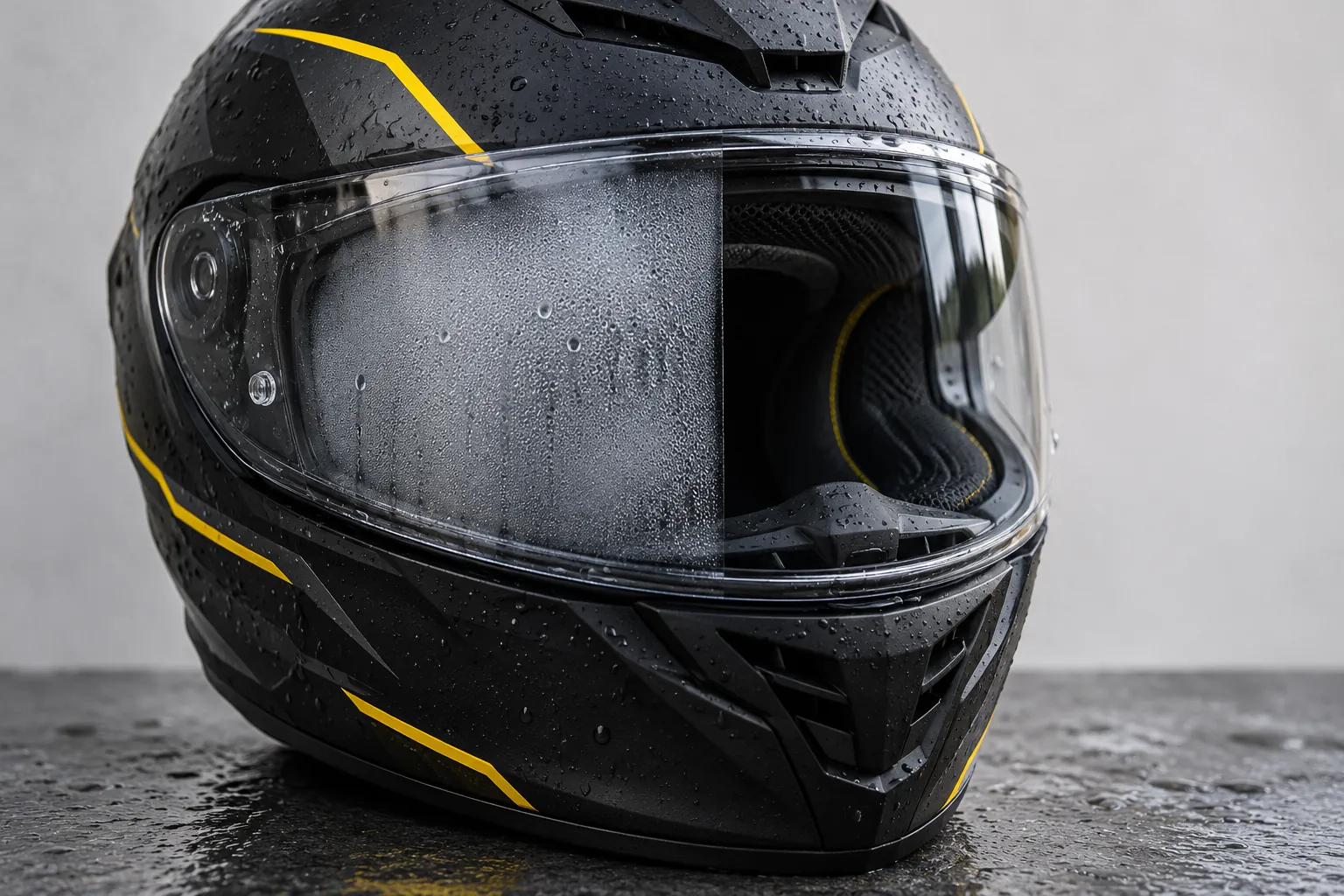
Key points
- The Pinlock is a second screen, a lens that attaches to the inside of the visor. According to its manufacturer, it retains water molecules and forms an airtight chamber with the visor.
- On a listing, three cases can be told apart: insert supplied with the helmet, visor prepared to receive one (the insert is then sold separately), or no mention.
- A Pinlock insert is chosen for a specific helmet: the manufacturer matches it to each helmet by a reference number.
- A listing that says nothing proves nothing: the helmet manufacturer's instructions are what count.
This article is for anyone who rides in cold or damp weather and wonders whether the anti-fog insert should come with the helmet they buy. It explains what the Pinlock does according to its manufacturer, what the words “supplied” and “prepared” cover on the listings, and what the catalogue declares. The tables come from MotoComparo and are recalculated when the page opens; the technical facts refer to the sources listed at the end of the article. The site has no test bench: no helmet and no insert has been tested, and no anti-fog product is recommended here.
What the Pinlock insert does
According to the manufacturer's “Technology” page, the technology rests on two principles. The first is an absorbent layer, which captures and stores water molecules when the air is humid, then releases them by evaporation when the humidity drops. The second is an airtight chamber: the seal forms a pocket of air between the visor and the insert, which acts as a thermal barrier and prevents condensation on the visor.
The manufacturer does not quantify the insert's effectiveness or its lifespan in the pages consulted. This article therefore makes no promises about them either.
Supplied, prepared or absent: reading the listing
The listings distinguish two situations. “Supplied” means that the insert comes with the helmet. “Prepared” means that the visor is fitted to receive one, sold separately. Here is what the listings for comparable helmets in the catalogue declare:
| Pinlock (anti-fog insert) | Fiches | Median price | Lowest price |
|---|---|---|---|
| Visor prepared, insert sold separately | 1 321 | 183,53 € | 35,95 € |
| Insert supplied with the helmet | 773 | 287,24 € | 74,93 € |
Of 6 625 comparable listings in the category, 2 094 state this feature on their merchant page (32%). The others simply do not mention it — it is not a confirmed absence.
The median price of the listings that advertise a supplied insert is 287,24 €, compared with 183,53 € for prepared visors. These two groups mix different brands, helmet types and ranges: the gap between medians does not measure what the insert adds to the price of the same helmet.
The table counts only the listings that mention a Pinlock; a listing that says nothing does not prove the helmet lacks one. For a “prepared” visor, the price of the insert is added to that of the helmet: check this on the listing before comparing two offers.
Before buying: what the insert manufacturer says
- One insert per helmet. The manufacturer writes that a different insert exists for each helmet, and that a reference number (DKS) identifies the right model, repeated on the helmet's product page (“Mount” page). Before buying an insert separately, compare this number with the one on the helmet listing.
- Pin fixing. The insert sits between two pins on the visor, and the silicone seal must be in full contact with it (Support). Some helmet brands, including Shoei, Arai, HJC, LS2, Schuberth and Nolan, use their own pins.
- Specific care. The manufacturer asks you to rinse the insert in mineral water only, wipe it with a damp microfibre cloth, let it dry naturally in an upright position, and store it away from moisture and dust. It warns that the insert is easily scratched. If the insert eventually works loose, it describes adjusting the pins in steps of no more than 45° (Support).
To compare today's prices
- Full-face helmets, flip-ups and open-face helmets, gold the whole helmet range.
- Open-face, flip-up or full-face: helmet shape and the ECE 22.06 standard.
- Motorcycle rainwear, from helmet to boots.
- Finding your helmet size and comparing two prices without being misled.
Frequently asked questions
What is a Pinlock?
A second screen that attaches to the inside of the visor. According to its manufacturer, it combines a layer that retains water and an airtight air chamber between the insert and the visor (Pinlock).
What does a “Pinlock-prepared” helmet mean?
The visor is fitted to receive an insert, which is sold separately. A helmet with an insert “supplied” comes with it.
Does a Pinlock fit any helmet?
No. The manufacturer states that a different insert exists for each helmet, and that a reference number (DKS) identifies the right one (Pinlock). Compare it with the one on the helmet listing.
How do you care for a Pinlock insert?
The manufacturer says to rinse it in mineral water only, wipe it with a damp microfibre cloth and let it dry naturally, in an upright position (Pinlock).
Is a helmet with no mention of a Pinlock without one?
Not necessarily: a listing that says nothing does not mean it has been found to be absent. The helmet manufacturer's instructions are what count.
Sources
- Technology, Pinlock (manufacturer of anti-fog inserts).
- Mount, frequently asked questions on installation, adjustment and care, Pinlock.
Read also
- Open-face, flip-up or full-face helmet: what does the ECE 22.06 standard say?
Open-face, full-face or flip-up: what the ECE 22.06 standard tests on each type of helmet, how to read the P, J or P/J label, and which type for which use.
- Winter motorcycle boots: the EN 13634 standard and waterproofing
The four digits of the EN 13634 standard on a motorcycle boot, and why it does not guarantee waterproofing: what the catalogue listings state.
- Approved motorcycle trousers: classes A, AA, AAA and knees
Classes A, AA and AAA of the EN 17092 standard, levels 1 and 2 of knee armour: what the law requires and what the trouser listings state.

