
Open-face, flip-up or full-face helmet: what does the ECE 22.06 standard say?
 Written by the MotoComparo team, independent comparison site · prices checked every day
Key points
- An open-face helmet, a flip-up and a full-face can all be ECE 22.06 approved without protecting the same area: only the full-face and the closed flip-up have an impact-tested protective chin guard.
- The label sewn onto the chin strap says so with a letter placed after the approval number: P (protective chin guard), J (open-face, no chin guard), NP (non-protective chin guard) or P/J (flip-up approved in both positions).
- A flip-up marked only P must not be ridden open on the road; it needs the double mention P/J, according to the French road safety authority (Sécurité routière).
- For better protection, Sécurité routière recommends the full-face over the open-face; whatever the type, the right size and a fastened chin strap matter as much as the shape.
This article is for anyone torn between an open-face, a flip-up and a full-face, who sees letters on the listings that they cannot interpret. It explains what the ECE 22.06 standard contains, what it tests depending on the type of helmet, how to read the label and what the law says in France. The tables come from the MotoComparo catalogue and are recalculated when the page opens; the technical and legal facts are taken from the sources listed at the end of the article.
The ECE 22.06 standard in a nutshell
ECE 22.06 is the “06” series of amendments to United Nations Regulation No. 22, which sets the approval conditions for protective helmets and their visors for riders and passengers of motorcycles and mopeds. This series came into force on 3 January 2021 (consolidated UNECE text). For details of what the 06 series adds, see the explainer.
The text sets out a transition in three stages. Eighteen months after entry into force, no new approval is issued without complying with the 06 series. Thirty months after, the approval marks of the previous series can no longer be applied to helmets. Thirty-six months after, the states applying the regulation may prohibit the sale of helmets that do not comply with the 06 series. The regulation therefore leaves this last choice to each state; what applies in France is detailed below.
What the standard tests, type by type
All ECE 22.06 approved helmets undergo tests on the shell, the rigid casing that gives the helmet its shape. The regulation provides for impacts at several points, at several speeds and on two types of anvil (the surfaces onto which the helmet is dropped), a rotation test (an oblique impact that measures the rotational acceleration experienced by the head), tests of the retention system, a minimum field of vision and requirements for the visor.
The regulation thus sets a maximum value for the rotational acceleration measured during the oblique impact, and a brain injury criterion that must not be exceeded. The difference between helmet types lies in the lower face.
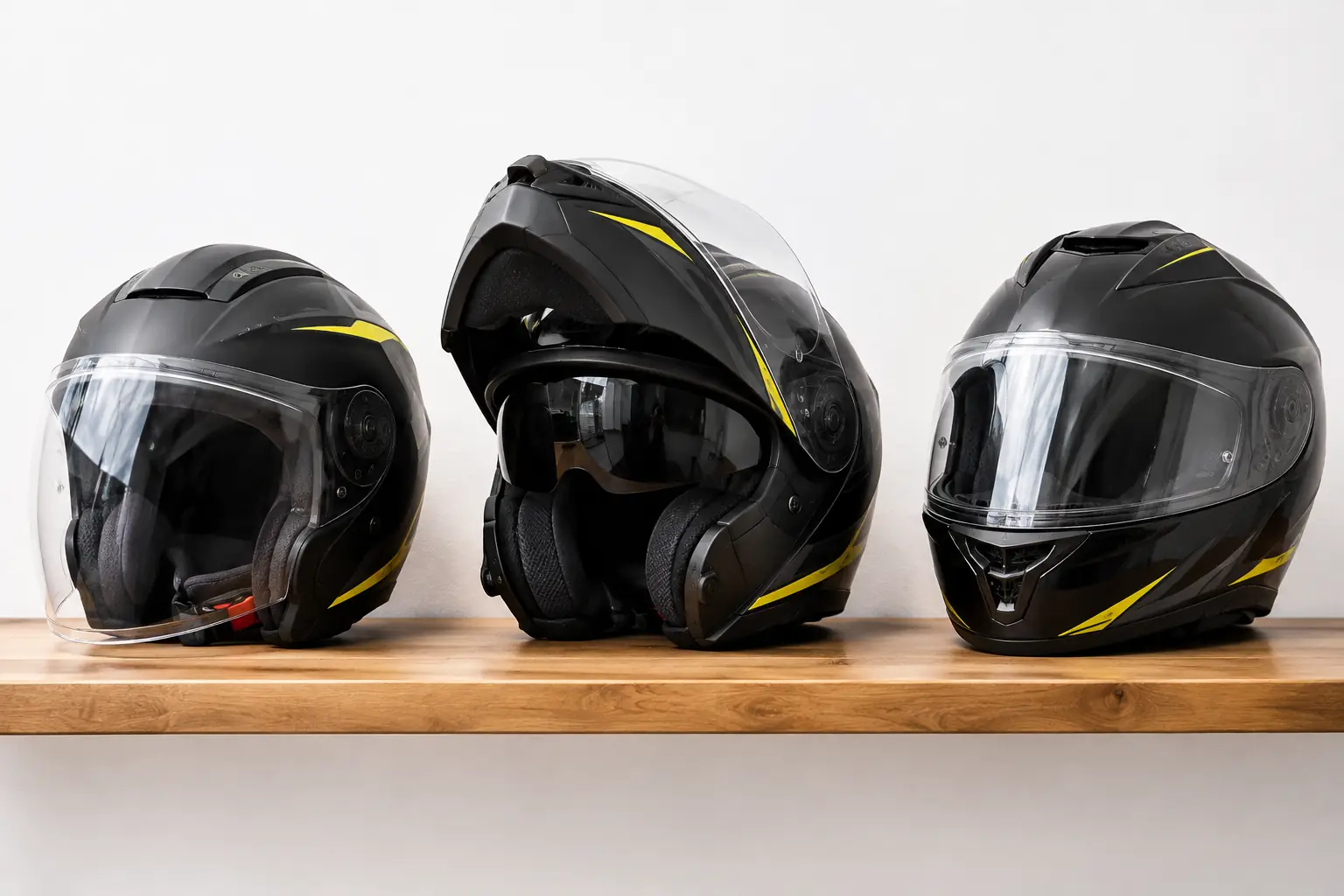
- Full-face. The chin guard is part of the helmet and it is protective: an additional impact point, at the chin, is tested on top of the others. Label: P.
- Open-face. The regulation defines it as a helmet with no part covering the lower face, with an open face. There is nothing to test at that spot, and the chin remains exposed. Label: J.
- Open-face with non-protective chin guard. Some helmets have a removable or movable piece that covers the lower face without protecting it. The regulation then requires this piece to be marked “Does not protect chin from impacts” or an equivalent symbol. Label: NP.
- Flip-up. The chin guard lifts up or comes off. The regulation defines the flip-up as a helmet whose protective chin guard meets the requirements in both situations, with or without the chin guard in place. Label: P/J.
The special case of the flip-up
The text specifies that chin protection is guaranteed only with the chin guard in place. A flip-up is therefore tested in both configurations for the retention test (the test that checks the helmet does not come off the head), and its movable chin guard undergoes a strength test in the open-face position. It must also have a device that holds it in place throughout the series of impacts, with a red-coloured control.
Reading the label: P, J, NP and P/J
The approval number of an ECE 22.06 helmet begins with “06”, which designates the series of amendments. It is followed by a slash and the helmet type symbol: J without chin guard, P with a protective chin guard, NP with a removable or movable non-protective chin guard, P/J with a removable or movable protective chin guard. A hyphen and a production serial number complete the marking, according to paragraph 5.1.4 of the regulation.
This mark is read on the chin strap label. It takes precedence over a merchant's listing: a listing that talks about a “CE-approved” helmet without citing the letter does not say which type it belongs to.
What the law requires in France
On the road, the rider and passenger of a motorcycle must wear a CE-approved, fastened helmet, according to Service-Public (page checked on 16 June 2026). The same page states that the helmet must carry four visible retroreflective elements, one at the front, one at the back and one on each side. The requirement derives from article R431-1 of the Highway Code.
Failure to comply is punished by a fine of up to €750, with the loss of three licence points when the offence is committed by the rider, according to Service-Public. The law does not choose between open-face, flip-up and full-face: any approved helmet satisfies the legal requirement. The choice of type therefore comes down to the protection sought, hence the value of the letter on the label.
What you can find on MotoComparo today
Number of comparable listings (sold by at least two merchants, with a known price) and lowest price by helmet type, calculated when this page opens:
| Type | Comparable listings | From |
|---|---|---|
| Full-face helmets | 2159 | 35,95 € |
| Helmet parts & accessories | 2022 | 1,35 € |
| Open-face helmets | 999 | 26,95 € |
| Motocross helmets | 860 | 56,25 € |
| Flip-up helmets | 601 | 56,23 € |
The lowest prices say nothing about protection: an entry-level open-face and full-face are both approved, on different areas. The table may also list other sub-categories, such as motocross helmets, which this article does not cover.
Declared SHARP ratings
Beyond the standard, the British SHARP programme (Safety Helmet Assessment and Rating Programme) has retail helmets tested under its own procedure and rates them from one to five stars; its results are public at sharp.dft.gov.uk. In its frequently asked questions, SHARP states that it has not tested open-face, motocross or adventure helmets, and focuses on full-face and flip-up helmets, which make up the vast majority of helmets sold. Breakdown of ratings (in stars) among the site's comparable helmets:
| Note de sécurité SHARP | Fiches | Median price | Lowest price |
|---|---|---|---|
| 4 | 476 | 299,19 € | 68,00 € |
| 5 | 219 | 399,20 € | 70,36 € |
| 3 | 47 | 137,94 € | 89,00 € |
Of 6 658 comparable listings in the category, 742 state this feature on their merchant page (11%). The others simply do not mention it — it is not a confirmed absence.
This table counts the listings that state a rating; a listing that says nothing is not a badly rated helmet. For flip-ups, SHARP also publishes a latch score, the percentage of impacts after which the chin guard stays locked, separate from the star rating (SHARP's explanation).
Which type for which use
Sécurité routière comes down in favour of the full-face: for better protection, it is preferable to the open-face, because it alone can reduce injuries to the face, chin and lower jaw. It adds that it reduces noise and wind blast, protects better from the weather and reduces fatigue. These arguments apply on the road and the motorway.
- For maximum protection. The full-face, letter P, is the only type whose chin guard is always in place and tested.
- To be able to open the chin guard. The P/J flip-up opens when stationary without being removed. To ride open, the double mention is essential; a flip-up marked P alone is ridden closed.
- For an open face. The open-face, letter J, leaves the lower face unprotected. That is the limit of the type, not a manufacturing defect: the standard has nothing to test there.
Before buying, and to compare prices
Size matters as much as type. Sécurité routière recommends trying on your equipment to choose the right size, and notes that a helmet that is too large is a danger; a helmet that is badly fastened or not fastened is useless. The sizing guide explains how to measure your head circumference.
- The letter. Read it on the chin strap label: P, J, NP or P/J. If the listing does not mention it, ask the merchant.
- The series. The approval number begins with 06 for an ECE 22.06 helmet.
- The visor. Fogging on the visor is a separate subject; the helmet section of the guide riding in the rain covers it.
- The rest of the kit. The helmet is not everything: see the winter jacket and gloves by season.
To compare today's prices:
- Open-face helmets, flip-up helmets and full-face helmets.
- All helmets, all types together.
- An example comparison between two entry-level full-face helmets: LS2 FF818 Storm III or Scorpion Exo-530 Air.
- Standards for clothing and protectors, for the rest of the kit.
- Comparing two prices without being misled, and the current deals to spot the price drops recorded in the catalogue.
Frequently asked questions
Is an ECE 22.05 helmet still valid?
For riding, yes according to Service-Public, which states that the helmet must be approved to the ECE-06 or ECE-05 standards. The UNECE regulation does, however, provide that states may prohibit the sale of helmets that do not comply with the 06 series from thirty-six months after its entry into force.
Open-face or full-face: which protects better?
The full-face, according to Sécurité routière: it alone reduces injuries to the face, chin and lower jaw. The open-face, with no chin guard, is defined by the regulation as an open-face helmet whose lower face is not protected.
Can you ride with a flip-up helmet open?
Only if it carries the double mention P/J, which indicates approval in both positions. A flip-up marked P alone cannot be worn in the open position on the road (Sécurité routière).
What do the letters P, J, NP and P/J on the label mean?
J designates a helmet without a chin guard, P a helmet with a protective chin guard, NP a helmet with a removable or movable non-protective chin guard, P/J a helmet with a removable or movable protective chin guard, approved with and without it (UNECE Regulation No. 22, paragraph 5.1.4).
Does the SHARP rating cover open-face helmets?
No, according to SHARP's frequently asked questions, which state that it has not tested open-face, motocross or adventure helmets. The programme rates full-face and flip-up helmets from one to five stars.
Sources
- UN Regulation No. 22 (revision 5, 06 series of amendments), uniform provisions concerning the approval of protective helmets and their visors, UNECE, document dated 24 August 2021.
- Mandatory equipment for riding a motorcycle, Service-Public (DILA), page checked on 16 June 2026.
- Article R431-1 of the Highway Code, Légifrance.
- Motorised two-wheelers: getting equipped (brochure, September 2023), Sécurité routière.
- SHARP, Safety Helmet Assessment and Rating Programme, Department for Transport (United Kingdom).
- Selecting motorcycle helmets for assessment, SHARP frequently asked questions.
- What does the latch score mean in SHARP ratings?, SHARP, 23 January 2026.
Read also
- Visor fogging: Pinlock supplied, prepared or absent
What the Pinlock insert does against fogging, and the difference between a helmet supplied with the insert or only prepared for it: what the catalogue listings state.
- Winter motorcycle boots: the EN 13634 standard and waterproofing
The four digits of the EN 13634 standard on a motorcycle boot, and why it does not guarantee waterproofing: what the catalogue listings state.
- Approved motorcycle trousers: classes A, AA, AAA and knees
Classes A, AA and AAA of the EN 17092 standard, levels 1 and 2 of knee armour: what the law requires and what the trouser listings state.

