
Summer, mid-season or winter motorcycle gloves: how to choose
 Written by the MotoComparo team, independent comparison site · prices checked every day
Key points
- The season determines the lining and the waterproofing; protection depends on EN 13594, the same standard for all gloves, summer or winter.
- To ride from October to March, look for a glove approved to EN 13594 with a waterproof membrane (not just a water-repellent treatment), a thermal lining and a Long cuff.
- A perforated summer glove is designed for neither rain nor cold; it must still be approved just like a winter glove.
- A listing that says nothing about approval proves nothing: the label sewn inside and the manufacturer's instructions are what count.
This article is for anyone buying a pair of motorcycle gloves who is torn between a summer, mid-season or winter model. It recalls what the law requires, explains what EN 13594 measures, then details what really changes from one season to the next: water, cold, the cuff, the size. The tables come from the MotoComparo catalogue and are recalculated when the page is opened; the technical and legal facts are drawn from the sources listed at the end of the article.
What the law requires
Wearing approved gloves is compulsory for the rider and the passenger of a motorcycle, scooter or moped. The text is article R431-1-2 of the French Highway Code, in force since 20 November 2016 (Légifrance), created by decree no. 2016-1232.
Riding without compliant gloves exposes you to the fine for third-class offences and the loss of one licence point. The rule does not depend on the season: a summer glove must be approved just like a winter glove. The Service-Public page “Compulsory equipment for riding a motorcycle” lists gloves among the compulsory equipment, along with the helmet and the high-visibility vest.
EN 13594, in plain terms
An approved glove carries the EN 13594 reference on the label sewn inside, with a motorcyclist pictogram. The road safety authority (Sécurité routière) presents the glove as personal protective equipment “certified as such” and states that the standard offers two levels (“Équipez-vous” page).
According to the testing body SATRA, level 1 aims for protection with little ergonomic hindrance; level 2 offers higher protection, at the possible cost of more weight or hindrance. Level 2 also requires a longer cuff and a wrist fastening that must withstand a stronger pull (50 N, against 25 N at level 1).
The KP marking (for Knuckle protection) indicates that the knuckle shell has been impact-tested. According to SATRA, this test is optional at level 1 and mandatory at level 2. The absence of KP on a level 1 glove therefore does not mean there is no shell, only that it has not been tested under this protocol.
Again according to SATRA, abrasion resistance is tested on the palm, including its lining, with a P120-grit abrasive belt. Cut resistance follows the EN 388 method: at level 1, it applies only to the palm materials; at level 2, it covers all materials except that of the fourchettes (the strips of fabric between the fingers).
The standard covers abrasion, cut, impact and wrist retention. It says nothing about warmth or waterproofing: a winter glove is not “more protective” because it is lined, and a perforated summer glove may well be level 2.
What the listings in our catalogue declare
The following tables count the comparable gloves in the catalogue (sold by at least two merchants, with a known price) according to what their merchant listing states. They count what merchants declare: a listing that says nothing does not mean the glove lacks the feature. They are recalculated when the page is opened.
Declared season
| Season | Fiches | Median price | Lowest price |
|---|---|---|---|
| Summer | 1 474 | 48,00 € | 10,99 € |
| Summer | 781 | 44,00 € | 10,99 € |
| Winter | 694 | 59,25 € | 7,90 € |
| Mid-season | 641 | 62,00 € | 14,06 € |
Of 3 696 comparable listings in the category, 3 590 state this feature on their merchant page (97%). The others simply do not mention it — it is not a confirmed absence.
Among the listings that specify it, the most frequently declared season is “Summer”.
Declared approval
| Approval | Fiches | Median price | Lowest price |
|---|---|---|---|
| EN 13594 | 1 575 | 53,00 € | 16,77 € |
| CE | 624 | 53,61 € | 11,99 € |
Of 3 696 comparable listings in the category, 2 199 state this feature on their merchant page (59%). The others simply do not mention it — it is not a confirmed absence.
A listing that says only “CE” indicates personal protective equipment without citing the standard: it is the merchant who has not copied the reference, not necessarily the glove that lacks it. The sewn-in label, for its part, must mention EN 13594.
Knuckle protection tested (KP)
| Knuckle protection (KP) | Fiches | Median price | Lowest price |
|---|---|---|---|
| Yes | 1 824 | 53,99 € | 16,54 € |
Of 3 696 comparable listings in the category, 1 824 state this feature on their merchant page (49%). The others simply do not mention it — it is not a confirmed absence.
Summer, mid-season, winter: what changes
The choice of season concerns ventilation, insulation and water, never the right to ride. Four families stand out:
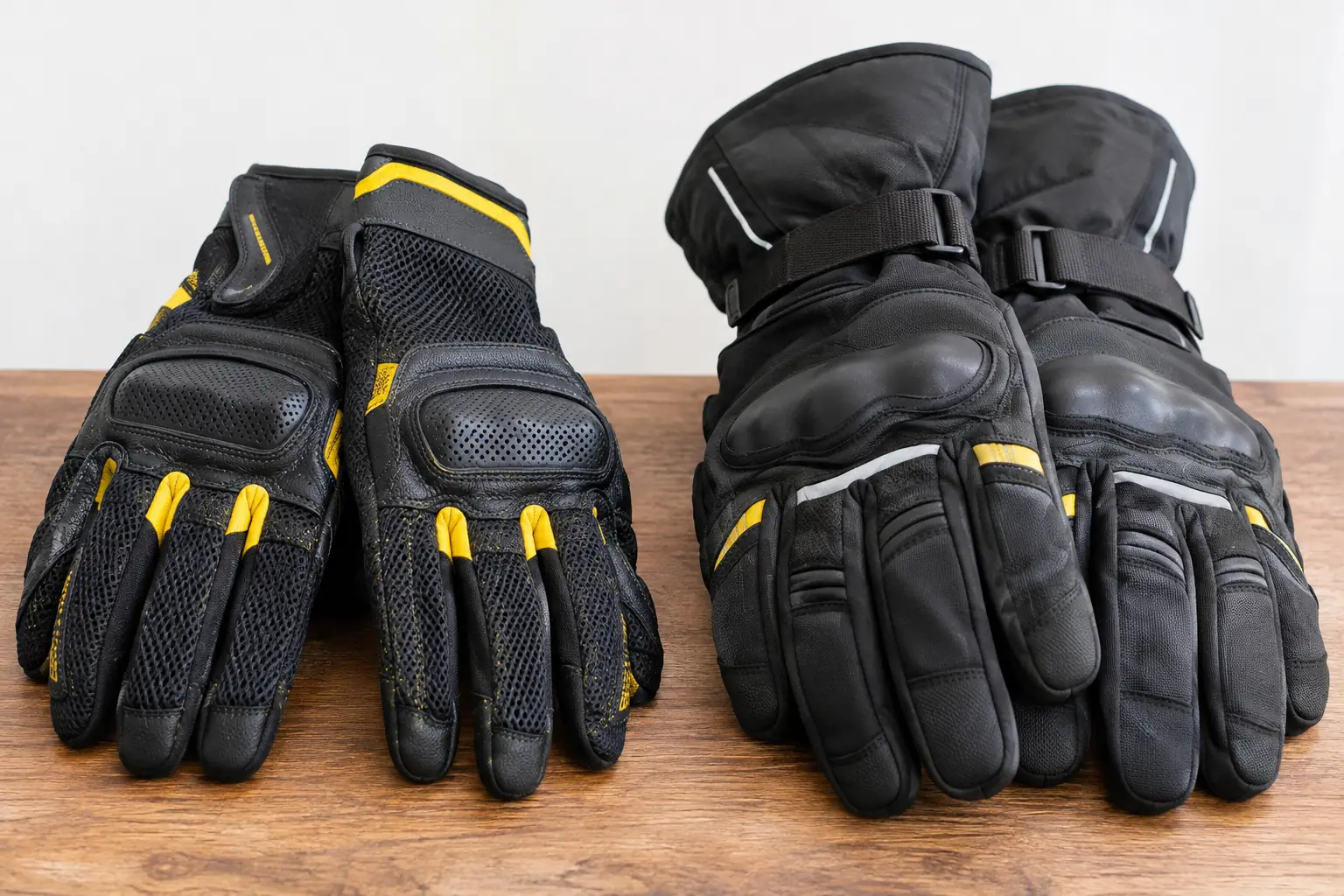
- Summer. Perforated leather or open-weave textile, often without a thermal lining or membrane: the priority is ventilation. These gloves get soaked in a shower and cool quickly as soon as the temperature drops.
- Mid-season. A compromise for spring and autumn: often waterproof, with a light lining, without being as insulating as a winter glove.
- Winter. Thermal lining and waterproof membrane, a long cuff that fastens over the sleeve of the jacket so that water and air cannot get in. The insulation adds bulk: the feel of the controls is less precise than with a thin glove.
- Heated. A heating element powered by a battery or by the motorcycle. It is the only solution that produces heat instead of merely retaining it; it is also the most expensive, and the listing always declares it explicitly.
Membrane or water-repellent: keeping water out
A membrane keeps water out; a water-repellent treatment alone does not. According to the manufacturer ixs, a membrane is a layer whose pores let water vapour pass from the inside to the outside but not raindrops (Gore-Tex is a branded example, other equivalents exist).
The water-repellent treatment (DWR, durable water repellent) is a very thin coating on the outer fabric that makes water bead, as Gore-Tex explains for its own products. It wears off over time and gives way in a long downpour: when water stops beading, it is no longer working properly, and the garment can feel cold and damp to the touch even if the membrane holds.
How to choose: size, cuff, use
A good choice follows this order: approval, use, water, then size. The road safety authority (Sécurité routière) recommends gloves that fully cover the hands and wrists without reducing the ability to ride, reinforced at the knuckles and palm, with a tightening strap that keeps them on in a slide. For the city, it suggests a light level 1 glove, and for the road a thicker level 2 glove.
- Approval. The label must cite EN 13594. The “Homologation” filter in the category excludes listings that do not cite it.
- The cuff. In winter, a long cuff fastens over the sleeve of the jacket; with a winter jacket, see winter motorcycle jackets: membrane, lining and class to match the set.
- The size. Measure around the hand above the thumb, fingers excluded, and refer to the brand's size guide: sizes do not match from one brand to another. A winter glove is bought in your usual size, not smaller: too tight, it restricts circulation and the fingers get cold faster.
Before buying: care and prolonged cold
- Care. Follow the manufacturer's instructions: a leather glove is cleaned and conditioned, and does not go in the washing machine unless stated otherwise. Washing it wrongly also damages the membrane, and the instructions take precedence over the general advice in the sources cited here.
- Prolonged cold. On a long journey in cold weather, no glove on its own keeps the fingers warm: heated grips, muffs or heated gloves then take over.
- Protection first. A highly insulating glove that fits badly or lacks approval is still a poor choice: warmth does not replace protection.
- The helmet and the rest. The hands are only one part of the equipment; for the helmet, see open-face, flip-up or full-face.
To compare today's prices:
- Winter gloves compared, mid-season gloves and summer gloves.
- All gloves, with the “Homologation” filter to keep only the listings that cite EN 13594.
- Standards for clothing and protectors (EN 17092, EN 1621, EN 13594).
- Comparing two prices without being misled, and the current deals to spot the price drops recorded in the catalogue.
Nothing above replaces the glove's sewn-in label or the manufacturer's instructions, the only sources that are authoritative in case of doubt about approval.
Frequently asked questions
Are gloves compulsory on a motorcycle, even in summer?
Yes. Article R431-1-2 of the French Highway Code requires compliant gloves for every motorcycle rider and passenger, without distinguishing seasons. The fine is that for third-class offences, with the loss of one licence point.
What is the difference between EN 13594 level 1 and level 2?
According to SATRA, level 1 aims for protection with little hindrance and level 2 for higher protection, with a longer cuff and a mandatory knuckle impact test. The road safety authority (Sécurité routière) suggests level 1 for the city and level 2 for the road.
What does KP mean on a motorcycle glove?
KP stands for Knuckle protection: the knuckle shell has been impact-tested under the standard. A glove without KP may have a shell not tested under this protocol; the listing or the label will say.
Is a water-repellent glove waterproof?
No, not durably. Water-repellent is a surface treatment that wears off (Gore-Tex, iXS), whereas the membrane is an inner layer that holds back water. For rain, look for the word “membrane” on the listing.
How can I avoid cold hands on a motorcycle?
Choose a winter glove with a thermal lining, membrane and long cuff, in your usual size so as not to restrict circulation. On a long journey in cold weather, no glove is always enough: heated grips, muffs or heated gloves take over.
Sources
- Article R431-1-2 of the French Highway Code, Légifrance.
- Compulsory equipment for riding a motorcycle, Service-Public (DILA), page checked on 16 June 2026.
- “Équipez-vous” campaign, “Gloves” section, Sécurité routière.
- EN 13594:2015, protective gloves for motorcycle riders, SATRA.
- Membrane (blog), iXS.
- Durable Water Repellent (DWR) in GORE-TEX Products, Gore-Tex.
Read also
- Heated motorcycle gloves: what to know before buying
Battery or connection to the motorcycle, heat levels, claimed battery life, EN 13594 standard: what manufacturers say and what the listings declare.
- Visor fogging: Pinlock supplied, prepared or absent
What the Pinlock insert does against fogging, and the difference between a helmet supplied with the insert or only prepared for it: what the catalogue listings state.
- Winter motorcycle boots: the EN 13634 standard and waterproofing
The four digits of the EN 13634 standard on a motorcycle boot, and why it does not guarantee waterproofing: what the catalogue listings state.

