
Motorcycle rain gear: from helmet to boots
 Written by the MotoComparo team, independent comparison site · prices checked every day
Key points
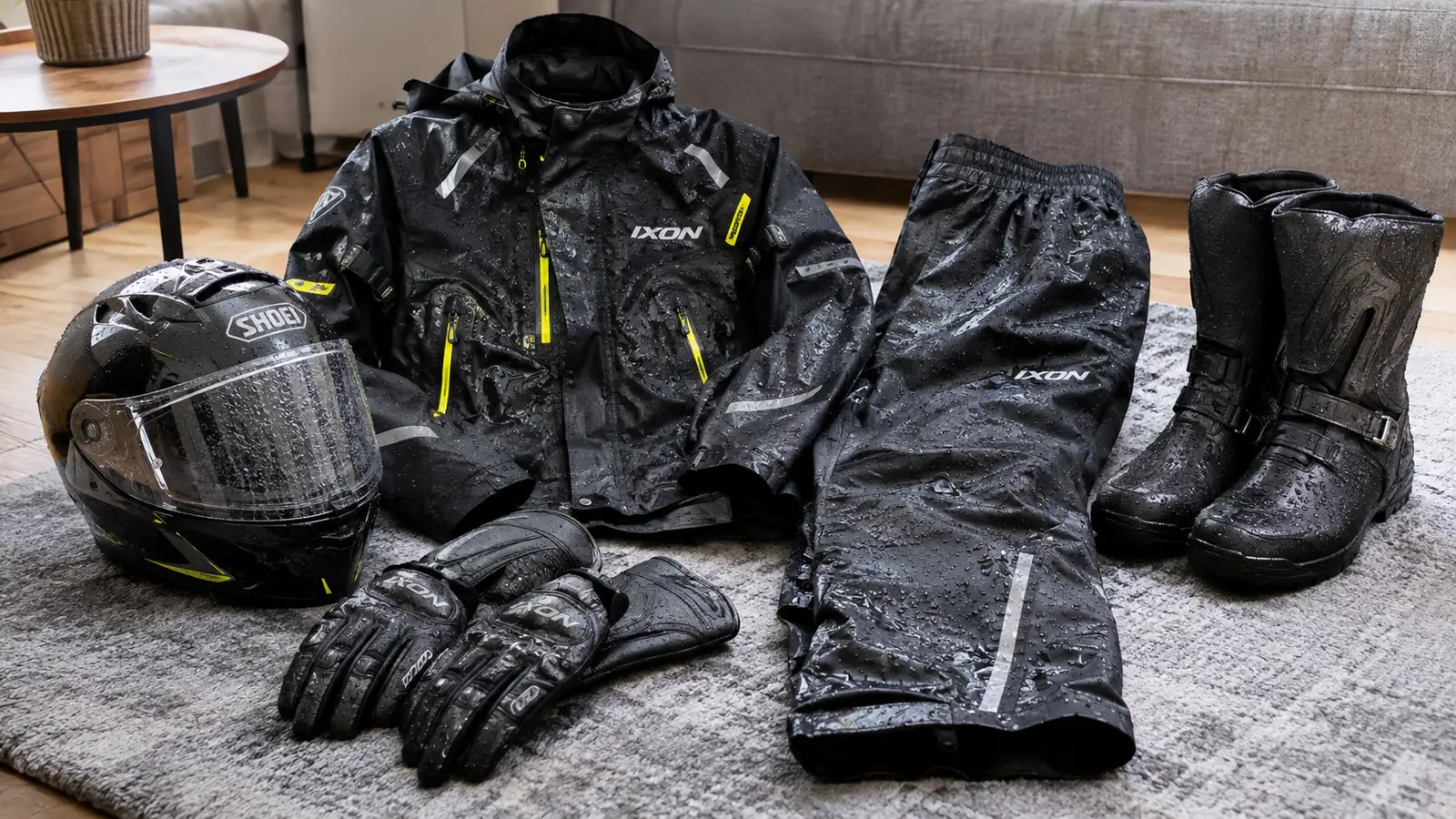
- The minimum list. To ride in the rain, five items matter: a helmet with an anti-mist visor, a jacket, trousers, gloves and boots that all state waterproofing.
- The deciding word. Look for “membrane” on the listings: a mere water-repellent treatment wears off and does not replace a membrane.
- Misting. A Pinlock insert supplied, or at least a visor prepared to take one, answers the problem of the misted-up visor.
- The limits. Dry gear does not make the road less slippery: the road safety authority (Sécurité routière) asks you to adapt your speed and to lengthen the safety distance.
This article is for anyone who rides all year round and wants to get equipped for autumn. It goes through the five items, from helmet to boots, and says for each which criterion really matters. The tables come from the MotoComparo catalogue: they count what merchants declare, recalculated when the page is opened. The technical and legal facts refer to a public source, listed at the end of the article. The site has no test bench: no product has been worn or tried.
What rain changes for the rider
The first difference is not in the equipment, but on the road. According to the road safety authority (Sécurité routière), there is half the tyre grip on tarmac in rainy weather as in dry weather, and also twice as many accidents. That page recommends favouring road tyres and checking tyre wear before setting off.
Its page on driving in rainy weather asks you to adapt your speed to the state of the road and to significantly lengthen the safety distance. It gives no figure for the braking distance of a motorcycle on a wet surface; the site therefore puts forward none.
The role of the equipment lies elsewhere: keeping the body dry so as to stay alert over time, keeping hands able to operate the controls, and seeing through the visor. That is what the following sections detail, item by item, starting with what underpins everything else: the difference between a membrane and a surface treatment.
A note on method. The tables in this article count only the comparable listings in the catalogue, that is, those sold by several merchants and whose price is known. They rank no product: they show how many listings declare a feature, and at what median price, to help place an offer.
Membrane or water-repellent: what “waterproof” means
Two words come up on all the listings, and they do not mean the same thing. A membrane is a thin layer, built into the garment, that stops liquid water. The water-repellent treatment (DWR, for durable water repellent) is a surface treatment applied to the outer fabric.
According to the manufacturer of Gore-Tex, it is the membrane that makes the fabric waterproof, windproof and breathable. The water-repellent forms a coating that makes water bead; without it, the surface loses that ability. The product then remains waterproof, but the outer fabric becomes saturated with water and comfort suffers.
The practical consequence comes down to one rule of thumb. Look for the word “membrane” or the name of a membrane, and consider that a water-repellent treatment alone protects against a shower, not necessarily against a long day of rain. A listing that mentions neither does not allow a conclusion: the feature is missing from the listing, not necessarily from the product.
The helmet: visor and misting
In the rain, the air is damp and the visor mists up more easily. The usual remedy on the market is the Pinlock insert, a second lens that attaches to the inside of the visor. According to its manufacturer, it rests on two principles: a surface that captures and retains water molecules, and an airtight seal that forms a thermal barrier and prevents condensation on the visor.
The listings distinguish two situations. “Supplied” means that the insert comes with the helmet. “Prepared” means that the visor is equipped to take one, sold separately. Here is what the listings of comparable helmets in the catalogue declare:
| Pinlock (anti-mist insert) | Fiches | Median price | Lowest price |
|---|---|---|---|
| Visor prepared, insert sold separately | 1 324 | 182,07 € | 35,95 € |
| Insert supplied with the helmet | 783 | 287,26 € | 82,49 € |
Of 6 504 comparable listings in the category, 2 107 state this feature on their merchant page (32%). The others simply do not mention it — it is not a confirmed absence.
The table counts only the listings that mention a Pinlock; a listing that says nothing does not prove that the helmet lacks one. In the case of a “prepared” visor, the price of the insert is added to that of the helmet: check the listing before comparing two offers. Our guide misting on the visor: Pinlock supplied, prepared or absent details these two cases.
To choose the shape and standard of the helmet, the guide open-face, flip-up or full-face explains the ECE 22.06 label. Helmets are compared in the helmets category, or by type: full-face, flip-up and open-face.
The jacket and the trousers
These are the items that cover the most surface, and those where the membrane / water-repellent distinction weighs the most. The selection process comes down to three steps.
- Look for a membrane declared on the listing, or its name.
- Check that the garment remains CE-approved: waterproofing takes nothing away from the protection requirement (see the reference on standards).
- Look at the advertised season: some outfits are designed for the cold, others for mid-season.
For jackets, the feature winter motorcycle jackets: membrane, lining and EN 17092 class details the figures for the category. Jackets can be filtered by season: winter and mid-season. Trousers are gathered in the trousers category, where the membrane is read in the features of each listing.
The gloves
Hands must stay dry while keeping the feel of the controls. The deciding criterion is the same as for the garment: membrane or mere water-repellent. Gloves remain subject to the approval requirement; the guide summer, mid-season or winter gloves recalls the law and EN 13594. Here are, among the listings of comparable gloves in the catalogue, those that declare waterproofing:
| Waterproof | Fiches | Median price | Lowest price |
|---|---|---|---|
| Yes | 1 038 | 61,60 € | 9,95 € |
Of 3 752 comparable listings in the category, 1 038 state this feature on their merchant page (28%). The others simply do not mention it — it is not a confirmed absence.
This table does not distinguish the membrane from the water-repellent: you have to open the listing to find out the exact word used by the merchant. Winter gloves are compared in the category filtered by season, mid-season gloves in this one.
The boots
Motorcycle boots come under EN 13634. According to the testing body SATRA, this standard provides for five optional properties, which the manufacturer has tested only if it wants to claim a specific performance. Resistance to water penetration is one of them.
When a listing names the membrane (Gore-Tex, Drystar, Hydratex and others), the name indicates which one is used, not its performance level. Here are the membranes named in the listings of comparable boots in the catalogue:
| Named membrane | Fiches | Median price | Lowest price |
|---|---|---|---|
| Gore-Tex | 223 | 237,92 € | 91,99 € |
| Drystar | 84 | 160,27 € | 124,00 € |
| T-Dry | 53 | 149,16 € | 77,99 € |
| Aquatech | 32 | 186,70 € | 129,27 € |
| Hipora | 26 | 135,92 € | 68,50 € |
| Hydratex | 23 | 159,95 € | 107,99 € |
| Sympatex | 19 | 176,33 € | 109,99 € |
| Waterstop | 14 | 169,15 € | 135,15 € |
| H-Dry | 7 | 220,20 € | 109,00 € |
| RainSeal | 6 | 96,52 € | 83,35 € |
| OutDry | 3 | 215,64 € | 91,78 € |
| Aerotex | 1 | 111,00 € | 111,00 € |
Of 2 260 comparable listings in the category, 491 state this feature on their merchant page (22%). The others simply do not mention it — it is not a confirmed absence.
Boots are compared in the boots category, which can be limited to the listings that cite EN 13634.
What equipment does not fix
Dry gear does not make the road less slippery. The road safety authority (Sécurité routière) reminds us that a wet road surface reduces tyre grip and that excessive speed exposes you to skidding through aquaplaning (the moment when the tyre glides on a film of water). It also states that a worn or bald tyre increases the risk of skidding and therefore of falling.
To see and be seen, the same page specifies that dipped headlights must sometimes replace main beam so as not to dazzle other road users. Listings often mention reflective elements; the presence of a strip is not a guarantee of visibility, and the listing does not measure it.
Autumn adds cold to rain. The road safety authority (Sécurité routière) notes that riding in low temperatures tires you without your realising it, and advises taking breaks, drinking hot drinks and resting at regular intervals. Its checklist before a long journey incidentally includes protection against bad weather (wind, rain, snow) and equipment meeting European standards: the two go together.
How to read a listing without being misled
A merchant listing is written by the seller, not the manufacturer, and each merchant chooses what to copy. Three habits avoid mistakes. Compare the same word from one listing to another: “waterproof membrane” and “water-repellent” do not mean the same thing. Deduce nothing from silence: a feature missing from a listing is not a confirmed absence. And, if in doubt, open the manufacturer's instructions, which are authoritative on protection as well as on waterproofing.
Finally, comparing prices remains useful in season: the deals page lists the price drops recorded, and the reference comparing two prices without being misled recalls the pitfalls of size, shipping and vintage.
Frequently asked questions
What is the difference between waterproof and water-repellent?
The manufacturer of Gore-Tex distinguishes the membrane, which makes the fabric waterproof, from the water-repellent, a surface treatment that makes water bead. The water-repellent wears off and must be reactivated or renewed; without it, the product remains waterproof but comfort drops.
Does a Pinlock really prevent misting?
Its manufacturer describes two mechanisms: a surface that retains water and an airtight seal that insulates the visor. The site has measured no results and therefore does not promise the total absence of misting; it only indicates which helmets declare it supplied or prepared.
Are approved boots necessarily waterproof?
No. According to SATRA, resistance to water penetration is one of the optional properties of EN 13634. An approved boot has therefore not necessarily undergone this test: consult the manufacturer's instructions.
By how much does grip decrease in the rain?
The road safety authority (Sécurité routière) states that there is half the tyre grip on tarmac in rainy weather as in dry weather. On the pages consulted, it gives no figure for the braking distance of a motorcycle on a wet surface.
Does waterproof equipment let you ride as in dry weather?
No. The equipment keeps the body dry, it does not change tyre grip. The road safety authority (Sécurité routière) asks you to adapt your speed to the state of the road and to significantly lengthen the safety distance.
Sources
- Grand tourisme à moto, Sécurité routière
- Conduire par temps de pluie, Sécurité routière
- Durable Water Repellent (DWR) in GORE-TEX Products, Gore-Tex
- Technology, Pinlock
- EN 13634, protective footwear for motorcycle riders, SATRA
Read also
- Visor fogging: Pinlock supplied, prepared or absent
What the Pinlock insert does against fogging, and the difference between a helmet supplied with the insert or only prepared for it: what the catalogue listings state.
- Winter motorcycle boots: the EN 13634 standard and waterproofing
The four digits of the EN 13634 standard on a motorcycle boot, and why it does not guarantee waterproofing: what the catalogue listings state.
- Approved motorcycle trousers: classes A, AA, AAA and knees
Classes A, AA and AAA of the EN 17092 standard, levels 1 and 2 of knee armour: what the law requires and what the trouser listings state.

